

Structure Benefits and Applications
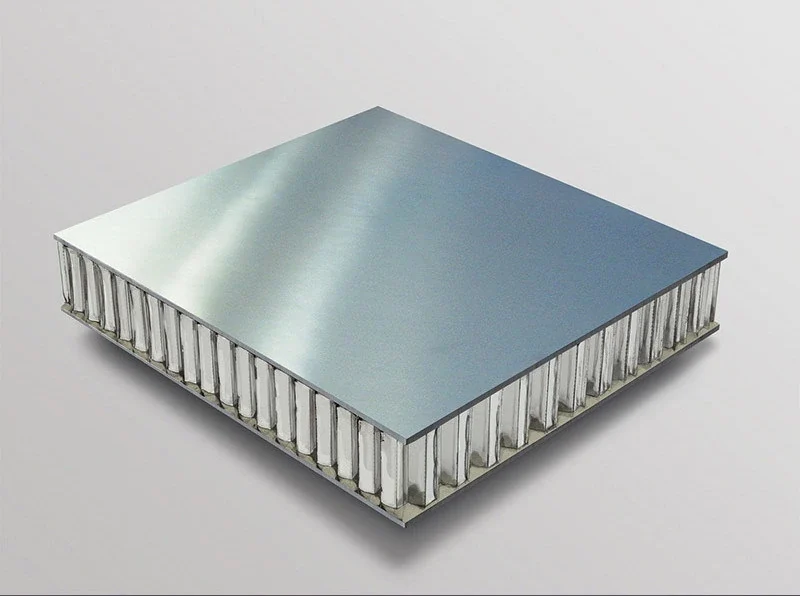
Aluminum honeycomb panels are sandwich panels made from two aluminum face sheets bonded to an aluminum honeycomb core. The core contains repeated cells, usually hexagonal, that separate and support the outer skins while keeping much of the panel interior hollow.
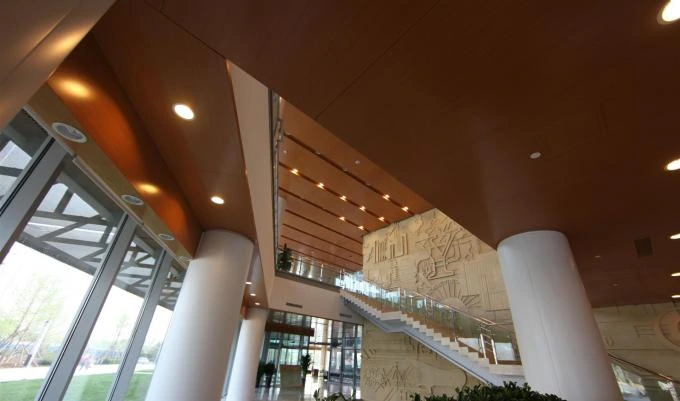
This construction gives designers a way to create stiff panels without using solid metal through the full thickness. In architectural projects, aluminum honeycomb sandwich panels are used for ceilings, wall surfaces and other fabricated elements where panel size, weight and surface appearance matter.
For buyers, the important distinction is between the honeycomb core alone and a finished panel. A complete panel includes the skins, bonding system, core and specified edges or attachments. Their combined design determines how the product performs.
How Is an Aluminum Honeycomb Panel Constructed
The main parts are a front aluminum skin, a rear aluminum skin and the honeycomb core between them. Bonding layers join the skins to the cell edges. The exposed face can receive the specified finish, while edge closures and fixing details complete the fabricated panel.
| Component | Main function | Important specification |
| Front skin | Forms the visible surface and contributes to bending resistance | Alloy, thickness and finish |
| Honeycomb core | Separates and supports the skins and transfers shear | Core height, cell size, foil thickness and density |
| Rear skin | Completes the sandwich and contributes to bending resistance | Alloy, thickness and back treatment |
| Bonding system | Transfers loads between skins and core | Bond strength, durability and service conditions |
| Edges and attachment details | Finish the panel and transfer loads to supports | Closures, inserts, brackets and connections |
Overall panel thickness and aluminum skin thickness are different measurements. A 20 mm honeycomb panel is not a 20 mm solid aluminum plate. Its weight and mechanical properties depend on the complete sandwich construction.
Likewise, “aluminum honeycomb sheet” can describe either exposed core material or a finished sandwich sheet. Include a section drawing when requesting quotations so suppliers price the same construction.
Why Does the Honeycomb Structure Improve Stiffness
When a sandwich panel bends, its separated face sheets resist tension and compression. The bonded core helps keep those skins apart and transfers shear between them. The result can provide useful bending stiffness at a relatively low panel weight.
Increasing the separation between the skins can increase bending stiffness, but overall thickness alone does not establish the allowable span. Skin thickness, core properties, bonding, support conditions and loads all influence the result.
This distinction matters for large ceiling and wall panels. A panel may feel rigid when handled yet still need additional supports or a different construction to meet the project’s deflection limits. Use design data for the proposed panel and fixing arrangement.
How Are Aluminum Honeycomb Panels Made
A common core manufacturing route begins with aluminum foil carrying patterned adhesive lines. The foil is stacked and bonded into a block, cut to the required core height, and expanded to form the cellular structure.
Panel production then brings the prepared core together with the front and rear skins. The selected bonding process joins them into a sandwich, followed by trimming, edge treatment and any specified machining or attachment details. Coating may be applied to the skins before assembly, depending on the product.
This is why bond quality deserves the same attention as the visible finish. A good-looking face does not establish how well the core and skins will work together under load or environmental exposure. For a project sample, review the section, edge closures and attachments as well as the front surface.
Benefits of Aluminum Honeycomb Panels
Low Weight for the Available Panel Depth
The cellular core replaces much of the material that would fill a solid plate of the same overall thickness. This helps reduce weight while retaining depth within the sandwich.
The practical saving depends on the reference material and construction. Request the finished panel weight per square meter, including closures and attachments, rather than using a generic percentage reduction.
Stiffness for Larger Architectural Surfaces
A bonded sandwich can support larger panel formats with a relatively stiff face. This can help designers develop broad ceiling or wall surfaces with fewer joints.
The final layout still needs coordinated panel dimensions, support spacing and installation tolerances. Maximum manufacturing size is not the same as an approved unsupported span.
A Flat Surface for Specified Finishes
Honeycomb construction can provide a flat substrate for architectural finishes. The visible result also depends on manufacturing quality, skin thickness, handling and the direction of light across the surface.
Review a representative sample or mock-up under the intended lighting. Thin skins can still suffer local dents, and poorly controlled bonding or handling can affect the finished appearance.
Choice of Decorative Appearance
Aluminum honeycomb panels can be supplied with different surface treatments. Color, texture and pattern allow the panel to coordinate with adjoining ceilings, wall cladding and interior finishes.
Where a finish is directional, record the intended panel orientation on the layout and packing labels.
GZSEASON Aluminum Honeycomb Panel Specifications
GZSEASON’s aluminum honeycomb panel range includes the following options for architectural projects.
| Item | Available specification |
| Listed aluminum alloy | 3003 |
| Maximum panel width | Up to 1500 mm |
| Maximum panel length | Up to 5000 mm |
| Overall panel thickness options | 8, 10, 12, 15, 20, 25 or 30 mm |
| Front aluminum skin thickness | 0.7–1.2 mm |
| Rear aluminum skin thickness | 0.5–1.0 mm |
| Face options | Solid or perforated |
| Finish options | Metallic effects, anodized, pre-coated PVDF, pre-coated polyester, and pre-coated wood or stone effects |
| Typical applications | Metro stations, museums and government buildings |
Select panel size, overall thickness, skins and core as one construction. Confirm the available combination, tolerances and support details through the project drawings before production.
When a buyer requests a 4 × 8 ft honeycomb panel, agree the exact manufactured dimensions in millimeters. Nominal imperial sizes and nearby metric formats should not be treated as interchangeable without checking the schedule.
Explore our architectural metal products and systems to compare honeycomb panels with other ceiling and cladding constructions.
Where Are Aluminum Honeycomb Panels Used
Ceiling Panels
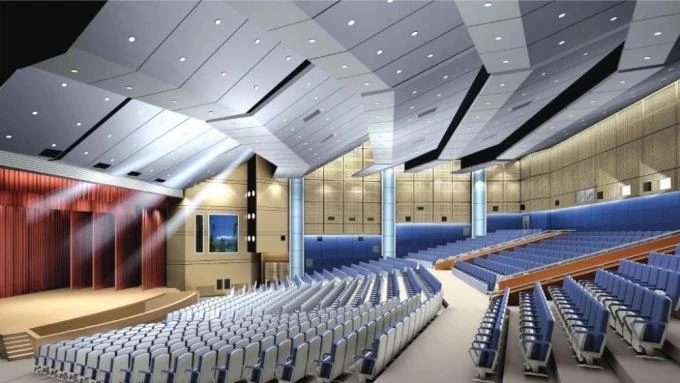
Aluminum honeycomb ceiling panels can create broad surfaces in public interiors. The design needs coordinated lighting openings, perimeter details and access to services above the ceiling.
GZSEASON’s range includes panels intended for spaces such as metro stations, museums and government buildings. Select the suspension and removal method for the actual panel arrangement; a honeycomb core does not identify the fixing system.
Wall Panels and Interior Features
Honeycomb wall panels can provide stiff decorative surfaces for architectural interiors. Coordinate panel edges, corner conditions and attachment points with the surrounding construction.
Where a design includes doors, handrails, screens or other attached equipment, establish the load path separately. Thin panel skins should not be assumed to accept concentrated loads without suitable reinforcement.
Exterior Cladding
For exterior use, the panel needs a complete facade design covering wind loads, fixings, movement, joints and drainage. Material and coating selection should reflect humidity, corrosion exposure and the intended service conditions.
Exterior suitability belongs to the proposed product and assembly. A panel selected for an interior ceiling should not be transferred into an exterior wall specification solely because both use aluminum skins.
Other Industrial Applications
Beyond architectural ceilings and walls, honeycomb constructions are used in areas such as transport interiors, cleanroom components and display or support panels. These uses may require different facings, adhesives, inserts, surface treatments or qualification procedures.
An architectural panel specification should therefore stay tied to its intended application. A panel suitable for a museum ceiling does not automatically meet the requirements for a vehicle floor, marine component or cleanroom enclosure.
Solid and Perforated Honeycomb Panels
A solid panel has a continuous visible face. A perforated version introduces openings into the face sheet and may be developed as part of an acoustic construction.
A perforated appearance does not by itself establish sound absorption. Acoustic performance depends on the hole pattern, core arrangement, backing, any absorptive material and the installation conditions. Request data for the complete proposed construction.
Sound absorption and sound isolation are different requirements. A ceiling designed to reduce reverberation inside a room does not automatically prevent sound transmission between rooms.
Honeycomb Panels Compared With ACM and Solid Aluminum
| Panel type | Basic construction | Main detail to compare |
| Aluminum honeycomb panel | Aluminum skins bonded around a cellular aluminum core | Core geometry, skins, bond and fixing details |
| Conventional ACM or ACP | Aluminum skins bonded to a polymer or mineral-filled core | Core formulation, skins, coating and fire documentation |
| Solid aluminum panel | An aluminum sheet formed into the required shape | Sheet thickness, stiffening and connections |
| Corrugated-core aluminum panel | Aluminum skins bonded around a corrugated core | Core profile, direction, bond and panel construction |
These products can have similar surface appearances while behaving differently. Compare their finished weights, design data, fabrication methods and project documentation for the same panel size and support conditions.
Are Aluminum Honeycomb Panels Fireproof and Waterproof
Aluminum skins and an aluminum core do not, on their own, establish the fire classification of a bonded panel. Adhesives, coatings and other components also matter. Specify the required fire performance and obtain documentation matching the proposed product and relevant installed construction.
Similarly, a metal face does not make every panel edge, opening or joint watertight. Exterior designs need coordinated closures, flashings, sealants and drainage. Water entry at exposed edges or damaged details can affect the construction.
Honeycomb panels should also not be assumed to provide the thermal performance of a dedicated insulation system. Where energy or acoustic targets apply, assess the complete wall or ceiling assembly.
What Should Buyers Check Before Ordering
A useful enquiry combines the panel schedule with a drawing showing the intended supports and edge conditions.
- Panel dimensions and tolerances, including overall thickness.
- Front and rear skin alloys and thicknesses.
- Core height, cell size, foil thickness and density.
- Bonding system and required durability documentation.
- Solid or perforated face and any acoustic construction.
- Surface finish, gloss, texture and pattern direction.
- Edge closures, inserts, connections and maintenance access.
- Project loads, exposure and required fire or acoustic evidence.
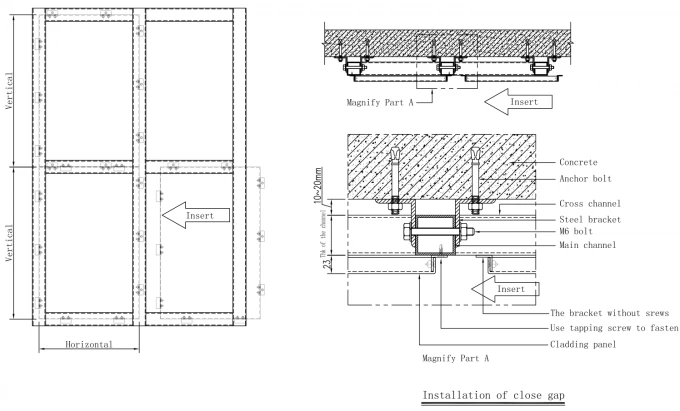
Review attachment points carefully. Loads may need inserts, reinforced edges or other designed details to prevent local crushing or pull-out. Use the selected manufacturer’s fabrication and installation instructions when developing those details.
For export projects, align panel references with the approved drawings and packing list. Agree protective packaging, lifting arrangements and storage requirements for large panels, and identify spare panels and accessories separately.
Discuss Your Honeycomb Panel Project With GZSEASON
Aluminum honeycomb panels combine metal skins with a bonded cellular core to provide useful stiffness at low weight for their overall thickness. Successful selection depends on the skins, core, bonding, finish and supporting details working together.
Browse our ceiling and architectural metal product range or review the GZSEASON online catalog. Share your drawings, panel dimensions, finish reference and performance requirements with GZSEASON to discuss a suitable aluminum honeycomb panel configuration.