Perforated metal is sheet metal containing a pattern of holes or slots. The openings allow light, air or sound to pass through the metal face, while the remaining material forms a continuous sheet that can be cut, folded and finished into architectural panels.
For building projects, a perforated metal sheet may become a ceiling panel, facade screen, wall lining or ventilation cover. Its suitability depends on the material, thickness, hole pattern, open area and supporting details working together.
A useful specification describes more than the appearance. Two panels with similar-looking holes can have different stiffness, visibility, airflow resistance and acoustic performance once installed.
How Is Perforated Metal Made
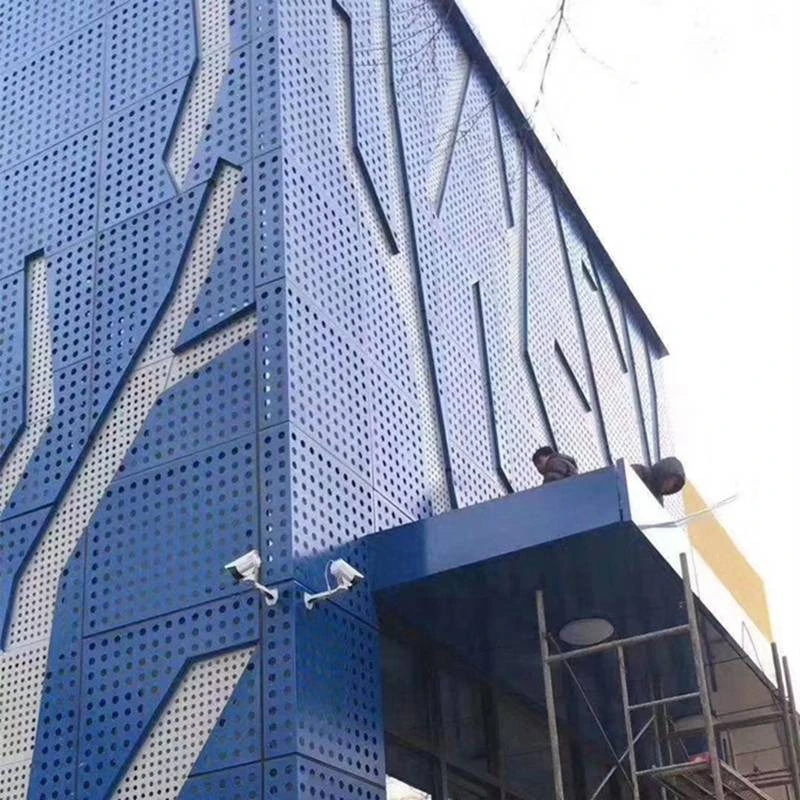
Regular perforations are commonly produced by punching holes through a sheet. CNC punching allows manufacturers to position repeated holes and leave unperforated zones for edges, bends and connections. Laser cutting can produce customized openings or more complex decorative patterns.
The sheet may then be cut to size, formed into the required panel geometry, deburred and finished. Agree the manufacturing sequence for the selected material and coating, particularly where holes and cut edges will be exposed to weather.
For a fabricated panel, the drawing should distinguish the flat blank from the finished face. Returns, corners, stiffeners and fixing zones affect both manufacturing and the installed result.
Common Perforated Metal Hole Patterns
The pattern influences appearance, available opening area and the metal remaining between holes.
| Padrão de furos | Visual arrangement | Important specification |
| Round | Circular openings in repeated rows | Diameter, pitch and straight or staggered layout |
| Square | Openings with straight sides | Side length, pitch and orientation |
| Slotted | Elongated openings | Width, length, end shape and direction |
| Decorativo | Repeated or customized shapes | Dimensioned drawing and minimum metal between openings |
Straight rows can create a strong linear pattern. Staggered holes create a different visual rhythm and can provide a different open area for the same hole diameter and pitch.
Specify pitch as a center-to-center dimension. It is different from the clear metal between adjacent holes. Also show the direction of the pattern relative to the panel edges.
For a continuous facade image or decorative arrangement, number the panels and mark their installation orientation. Otherwise, turning one panel can interrupt the intended pattern.
What Does Open Area Mean
Open area is the proportion of the sheet face occupied by openings. It helps describe a perforated metal panel, but it does not by itself establish ventilation capacity, sound absorption or structural adequacy.
For a regular round-hole pattern with equal pitch in both row directions, the theoretical percentage can be calculated from hole diameter and pitch. The formula depends on the arrangement.
| Round-hole arrangement | Theoretical open area percentage |
| Square pitch with straight rows | 78.54 × (diameter ÷ pitch)² |
| Equilateral triangular pitch with 60 degree stagger | 90.69 × (diameter ÷ pitch)² |
For example, 5 mm round holes on an 8 mm equilateral triangular pitch give approximately 35.4% open area within the perforated field. Unperforated borders, returns and fixing zones reduce the opening percentage when calculated across the whole panel.
Always identify whether a quoted percentage applies to the perforated field or the overall panel. For irregular patterns, calculate it from the approved drawing.
Increasing open area removes metal. Evaluate the resulting stiffness and support requirements rather than selecting a pattern only by its transparency.
Which Materials Are Used
Perforated metal sheet products are available in aluminum, carbon steel, galvanized steel and stainless steel. Select the material and finish for the application rather than treating all perforated sheets as interchangeable.
Perforated Aluminum Sheet
Aluminum is useful where panel weight, fabrication and decorative finish are important. Alloy and temper affect forming and mechanical behavior, so include them when the project requires a defined material grade.
For exterior work, coordinate the coating, fasteners and contact with other materials. Aluminum can corrode under unsuitable exposure or contact conditions even though it does not develop iron rust.
Galvanized and Other Steel Sheets
Galvanized steel uses a zinc coating to protect the steel substrate. The fabrication sequence and treatment of cut or punched edges deserve attention, especially in exposed environments.
Stainless steel offers another material route, with grade and surface finish selected for the exposure. A material name alone does not define corrosion resistance for every environment.
GZSEASON Perforated Panel Options
GZSEASON’s architectural perforated panel range includes the following options.
| Item | Especificações disponíveis |
| Materiais | Liga de alumínio ou aço galvanizado |
| Largura máxima do painel | Até 1.600 mm |
| Comprimento máximo do painel | Up to 6000 mm |
| Espessura do material | 0,4–4,0 mm |
| Hole patterns | Round, square, slotted and staggered arrangements |
| Pattern arrangement options | 45, 60 or 90 degree layouts, as applicable to the selected pattern |
| Acabamentos | Polyester coating, powder coating, PVDF coating and heat-transfer finishes |
| Aplicações típicas | Airports, metro stations and concert halls |
Select dimensions, thickness and pattern as one combination. The maximum available panel dimensions do not establish an allowable unsupported span or mean that every thickness is suitable for that format.
Compare options within our produtos e sistemas metálicos para arquitetura, then agree the panel construction through the approved drawings and samples.

Where Are Perforated Metal Panels Used
Metal Ceilings and Wall Linings
Perforated ceiling and wall panels can combine a metal face with openings for an acoustic construction. The panel connection still needs to match the selected ceiling or wall system.
A perforated face may be used in different panel families. Clip-in, lay-in and hook-on describe supporting or fixing methods, while perforated describes the face. Specify both details when comparing proposals.
Facade Screens and Sun Shading
A perforated facade screen can filter views and daylight while introducing a repeated pattern or decorative image. Review its appearance from normal viewing positions and under both daytime and nighttime lighting.
Openings do not create a weather barrier. Where the screen sits outside an enclosed building, coordinate the wall behind it, the drainage arrangement and the supporting frame.
Sun shading depends on geometry, orientation and the sun’s position. A stated open area alone does not establish the shading performance of a complete elevation.
Ventilation and Equipment Covers
Perforated sheets can provide openings around equipment or service zones. Airflow performance also depends on hole geometry, sheet thickness, obstructions and the permitted pressure drop.
Ask the relevant designer to assess the actual assembly. A decorative perforated cover should not be assumed to satisfy a ventilation or machinery-guarding requirement solely because it has holes.

Does Perforated Metal Absorb Sound
A perforated metal face is one component of an acoustic system. The openings can allow sound to reach an absorber or interact with a designed cavity, but the face pattern alone does not establish a sound absorption rating.
For an acoustic ceiling or wall lining, review the hole dimensions, open area, backing, absorber and cavity depth together. Request test data corresponding to the proposed assembly and installation conditions.
Absorbing sound within a room is different from stopping sound transmission between spaces. Define the acoustic objective before choosing the panel configuration.
Perforated Metal Compared With Expanded Metal and Wire Mesh
| Produto | How openings are formed | Main detail to compare |
| Perforated metal | Material is removed from a sheet to create holes | Hole size, pitch, borders and sheet thickness |
| Expanded metal | A sheet is slit and stretched into an open pattern | Strand dimensions, opening geometry and raised or flattened form |
| Wire mesh | Wires are woven or joined into a grid | Wire diameter, aperture and joining method |
These products can all create an open metal surface, but their texture, edges, stiffness and fabrication details differ. Compare the actual section and supporting arrangement rather than choosing by a photograph alone.
What Should Buyers Confirm Before Ordering
Provide a drawing showing the required panel geometry and pattern, together with the following information:
1. Material, alloy or grade, and thickness.
2. Finished panel dimensions and any formed returns.
3. Hole shape, dimensions, pitch and pattern direction.
4. Open area and the area used for that calculation.
5. Unperforated borders, fixing zones and service cutouts.
6. Required surface finish, color, gloss and texture.
7. Supports, connections and project design requirements.
8. Acoustic backing or other components included in the supply.
Review a physical sample for burrs, visible distortion, finish consistency and hole appearance. Where pattern alignment matters, include several adjoining panels in the sample assembly.
For export orders, align panel references and packing labels with the approved drawings. Agree protective packaging and handling arrangements so that thin panels and formed edges remain protected during transport and installation.

Discuss Your Perforated Metal Project With GZSEASON
Perforated metal sheets combine a continuous metal substrate with a controlled opening pattern. Good results depend on matching the material, hole geometry, finish and supporting system to the project’s visual and performance requirements.
Confira nossa metal ceiling and architectural panel range ou consulte o Catálogo online da GZSEASON. Share your drawings, pattern reference, panel sizes and finish requirements with GZSEASON to discuss a suitable perforated panel configuration.