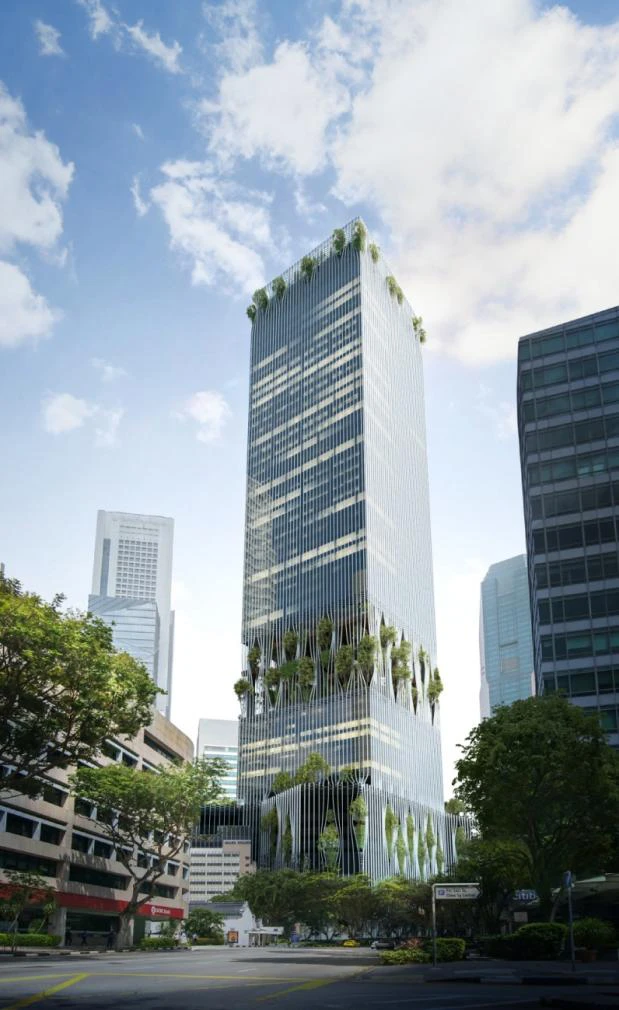

Laser cut aluminum panels are sheets with openings cut along digitally controlled paths. The retained metal creates a decorative pattern, while the openings allow views, light, and air to pass through. For a commercial screen, partition, or facade feature, develop the pattern together with the panel joints, borders, and supporting frame.
Start with an elevation showing adjacent panels at their installed positions. A full-size pattern sample helps the design team judge the appearance before the cutting files and finishing details are approved.
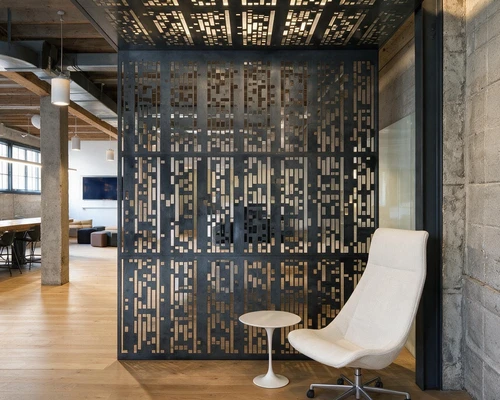
What Are Laser Cut Aluminum Panels
A laser follows programmed contours to remove selected areas from the sheet. Curves, straight lines, repeating motifs, and irregular outlines can be combined. The retained metal includes the visible motif, connecting bridges, and solid borders required for attachment.
Enclosed shapes within a pattern can become loose pieces when cut. Review the connections that retain them before releasing the artwork. Identify any separate decorative pieces and their attachment method on the drawings.
Laser cutting accommodates custom contours. Conventional punched perforations commonly use repeating holes made with tooling. Either process may suit a regular design, depending on geometry and quantity. Our perforated metal sheets and panels guide explains common hole patterns and applications.
How Pattern Design Affects the Finished Panel
Scale and viewing distance. Fine details can merge when viewed across a plaza. Large openings may expose the background wall or services. Review the complete elevation from its principal approach and inspect a sample at the intended viewing distance.
Continuity across joints. Include the actual panel gap in the artwork review. A motif reaching one panel edge needs an agreed alignment on the next. Number each panel and mark orientation, particularly where the design changes across an elevation.
Borders and bridges. Reserve metal around fixing holes and within the pattern. Ask the fabricator to review narrow connections, isolated features, and proximity to folds. Their dimensions depend on material, geometry, forming, and the support arrangement.
Privacy and transparency. Review the intended background and lighting on both sides. A screen may appear more open when the space behind it is brighter. Consider opening shape and viewing angle alongside the open-area percentage.
From Artwork to Fabricated Panels
Agree the production sequence around the proposed pattern, edge details, and finish.
| Stage | Items to review | Approval output |
| Artwork | File units, scale, closed contours, duplicate lines, and retained bridges | Consistent pattern file |
| Shop drawings | Panel IDs, joints, borders, folds, fixing holes, and orientation | Coordinated panel drawings |
| Découpe | Material identification, contours, and sensitive pattern details | Cut panels checked against drawings |
| Edge treatment and forming | Burr removal, exposed edges, folds, and dimensions | Panels ready for finishing |
| Finishing and packing | Finish sample, protection, labels, and packing order | Identified panels ready for shipment |
Confirm file formats with the fabricator. A vector or CAD file can define contours, supported by a dimensioned PDF showing the intended result. A photograph usually needs conversion and design review before it can define a cutting path.
Use a sample containing a representative pattern, a fixing border, and a folded edge where applicable. Check narrow features after finishing. If the pattern spans several panels, include a typical joint in the sample review.
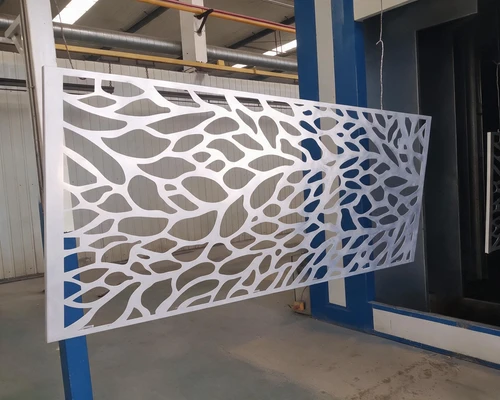
Panel Thickness, Borders, and Fixing Details
GZSEASON’s Laser Cut Hollowed Panel catalog range includes aluminum, galvanized steel, and stainless steel. Listed reference dimensions extend to 1400 mm wide and 5000 mm long, with thicknesses of 1.5–4.0 mm. Customized dimensions and thicknesses require review. For an aluminum proposal, confirm alloy, temper, thickness, and finished dimensions in the quotation and drawings.
The workable panel size depends on pattern geometry, unsupported span, folds, handling, and attachment. Coordinate project loads and supports with the responsible designer before choosing the final configuration.
A flat framed screen and a folded cassette require different edge details. Show fixing positions, fastener access, support interfaces, and movement allowances. Review corners and end panels alongside the repeated central bays.
For balconies, guards, or other protective applications, establish the assembly performance and opening criteria with the project team. Specify the panel together with its frame, fixings, and connections.
Découvrir decorative metal panel systems et perforated panel and metal mesh systems when discussing the product construction.
Finishes, Applications, and Sample Approval
GZSEASON’s catalog lists PE coating, powder coating, and heat-transfer finishes for this range. Select the finish for the exposure and appearance, then confirm pretreatment, color, gloss, and treatment at cut edges and folds. See our powder coating guide for related finish considerations.
The catalog identifies hotels, museums, and mosques as applications. An interior partition, decorative wall feature, and exterior screen each require coordination of the pattern, background, support arrangement, and access. Review the complete assembly for its intended location.
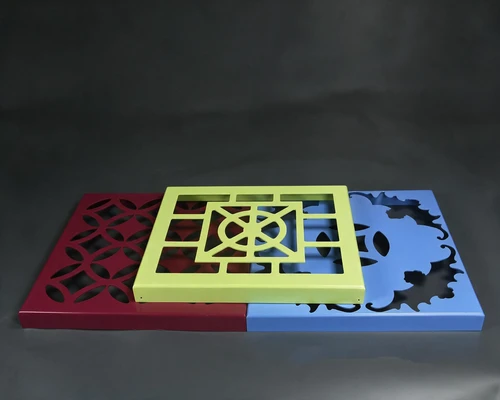
Before approving a sample, check the following details.
- Pattern scale and continuity across a panel joint
- Retained bridges, solid borders, and fixing positions
- Exposed edges and folded corner appearance
- Color, gloss, and directional finish alignment
- Visibility of the background and supporting components
- Panel identification, protection, and replacement method
For a quotation, send the panel layout, quantities, pattern files, dimensions, proposed material and finish, fixing concept, and project location. Include performance requirements and delivery constraints so the proposal covers the relevant interfaces.
Review the GZSEASON product catalog and share your drawings to discuss the pattern, fabrication details, and sample scope.